Pictured: Men digging out the train, probably near Minnie Munn’s Cut, north of Harvey St, Harbour Grace, ca. 1900.
Photo courtesy Gordon G. Pike Railway Museum archives.

Pictured: Men digging out the train, probably near Minnie Munn’s Cut, north of Harvey St, Harbour Grace, ca. 1900.
Photo courtesy Gordon G. Pike Railway Museum archives.

Follow the Harbour Grace Notebook series with the hashtag #hgnotebook on Facebook, Twitter and Instagram.
—
1 July 1851: First Presentation Sisters arrive in Harbour Grace.
1 July 1867: Cornerstone laid on Masonic Lodge by A.W. McKay. Still standing, the Lodge is the oldest in Newfoundland and the oldest wooden Masonic Lodge in Canada. More info: Heritage Foundation of NL.
4 July 1840: Bishop Aubrey Spencer officially consecrates St. Paul’s Church. More info: St. Paul’s Anglican Church.
4 July 1919: Handley Page Atlantic leaves Harbour Grace. More info: “Great Atlantic Air Race: Admiral Kerr in Harbour Grace,” by Dr. Lisa M. Daly.
5 July 1932: Century of Progress aircraft, piloted by Jimmy Matern and Bennett Griffin, arrives in Harbour Grace; leaves for Berlin, Germany, the same day
5 July 1919: Handley Page Atlantic forced to crash land at Parrsboro, Nova Scotia, after leaving Harbour Grace; the crew repaired the plane over the summer. “Great Atlantic Air Race: Admiral Kerr in Harbour Grace,” by Dr. Lisa M. Daly.

Handley Page Atlantic crashes at Parrsboro, NS
6 July 1829: Governor Sir Thomas Cochrane visits Harbour Grace to select a site for the new courthouse. He chooses the site where the courthouse is today. There is some suggestion that the courthouse should be built further west on Harvey St. More info: Harbour Grace Courthouse.
6 July 1860: Harbour Grace Volunteer Regiment forms. To approve the volunteer militia, a letter is sent to Magistrate Robert John Pinsent and signed by Captain John Hayward; Lieut. Henry T. Moore, and Robert Stewart Munn. The Regiment drilled at the Parade Grounds, near Military Rd, when weather permits, or at the Barracks. Rifle practice took place west of Target Hill, near Lady Lake.
9 July 1832: A meeting is held to discuss the best way of averting cholera from Harbour Grace. The group pass a resolution to start a subscription for the purposes of a hospital.
9 July 1837: St. Paul’s Church officially opens its doors. More info: St. Paul’s Anglican Church.
9 July 1860: Magistrate Robert John Pinsent sends letter allowing the formation of the Regiment and use of the Barracks. Sergeant Lucas Fallon, chief of police, is tasked with drilling the regiment.

Sergeant Lucas Fallon, 1817-1879
10 July 1945: Town of Harbour Grace becomes an incorporated municipality.
11 July 1883: Robert Crocker Bray, Samuel Comer Bray, and Ellen Coombs murdered at the Bray residence, near Church Path/Church Hill (Cochrane St). Bray’s plantation labourers, Peter Downing and Patrick Malone, are arrested for the killings. More info: Archival Moments / Gibbet Hill: Unfinished Justice by Patrick J. Collins.
13 July 1863: John March, future Bishop of Harbour Grace Diocese, born in Northern Bay. More info: Newfoundland Grand Banks.
13 July 1931: Justice for Hungary aircraft, piloted by Gyorgy Endresz and Alex Magyar, arrives in Harbour Grace.
14 July 1883: Funerals held for Robert Crocker Bray, Samuel Comer Bray and Ellen Coombs. More info: Archival Moments / Gibbet Hill: Unfinished Justice by Patrick J. Collins.
15 July 1931: Justice for Hungary aircraft leaves for Budapest, Hungary.
16 July 1826: King grants Sir Henry Pynn his royal license and permission to wear the insignia of a Knight Commander of the Royal Portuguese Army.
17 July 1799: George Gordon Cawley, a Newfoundland Regiment officer stationed in Harbour Grace, dies. His gravesite in St. Paul’s Anglican cemetery, Harbour Grace, is the oldest known gravesite of a Newfoundland Regiment officer. More info: St. Paul’s Anglican Church.

Gravesite of Lieut. George Gordon Cawley
20 July 1879: Tender posted in the Harbour Grace Standard: “The Building Committee of the Benevolent Irish Society will receive sealed tenders until Saturday, 28th instant, at noon, from persons wishing to contract for the erection of St. Patrick’s Hall. Plan and specifications can be seen on the application to the application to the Chairman. The Committee do not bind themselves to accept the lowest or any tender. Michael J. Jones, Chairman, Building Comittee.” St. Patrick’s Hall would be constructed near the bottom of Kingswell Lane, directly to the west.
“Movies were held at St. Patrick’s Hall in the town. Those were the days of the silents, in the early decades of the century. The feature pictures were usually western thrillers, but for many of the happy patrons, especially the youth, the main attraction was Charlie Chaplin. The admission was 10 cents for adults and 5 cents for other – and others tended to be legion!” – R.J. Connelly
22 July 1862: First Regatta held at Lady Lake (or Lady Pond), Harbour Grace.
25 July 1927: Harbour Grace Airport Trust Company, a 21-person committee, formed at the Town Hall.
25 July 1929: Bluenose aircraft, piloted by Vernon Darrell, arrives in Harbour Grace on a pleasure cruise.
27 July 1844: Dr. Edward Feild, lord bishop of the Church of England diocese, arrives at Harbour Grace in the packet Victoria. He preaches to a crowded congregation in St. Paul’s Church on the following morning (Sunday), and in the afternoon proceeds to Carbonear, returning to Harbour Grace for evening service. He raises 70 pounds for the Parsonage House soon to be erected in the parish.
27 July 1853: Work begins on the first public wharf in Harbour Grace, at the bottom of Victoria St.
27 July 1929: Bluenose leaves Harbour Grace for Sydney, Nova Scotia.
28 July 1835: Cornerstone laid for new Episcopal Church in Harbour Grace (St. Paul’s).
28 July 1904: Cornerstone laid for fourth Methodist church of Harbour Grace.
29 July 1933: “Bellanca aircraft,” piloted by George Pond, arrives in Harbour Grace.
29 July 1867: Letter in the Harbour Grace Standard: “I see by the ‘Supply’ Act of 1867 that the Legislature granted the sum of $6,000 for the erection of a Customs House in Harbour Grace. It is high time that the said building be commenced – even supposing a piece of land for the site thereof had to be purchased, the above handsome grant would be quite sufficient therefore, and for the erection of the building. If this not be done, we may well fear that the present contracted old crumbling apology for a Custom House will, before long, fall down…” More info: About Us: Customs House.
30 July 1934: “Pleasure cruise aircraft,” piloted by Paul Beso, arrives in Harbour Grace.
30 July 1846: Sir Thomas Roddick born at Harbour Grace, son of John Irving Roddick and Emma Jane Martin. More info: Dictionary of Canadian Biography.

Follow the Harbour Grace Notebook series with the hashtag #hgnotebook on Facebook, Twitter and Instagram.
—
1 June 1854: Death of Thomas Danson, a leading merchant and senior police magistrate in Harbour Grace.
1 June 1865: Bishop John Dalton’s pastoral letter grants Roman Catholic fisherman to fish on August 15, the date of the Feast of the Assumption, provided they gave the proceeds of their day’s catch to the Church. This ruling is the first known example of this practice, which still survives in some Newfoundland communities. More info: Dictionary of Canadian Biography.
2 June 1850: Work begins on widening Noad St, Victoria St, Bannerman St, LeMarchant St, Cochrane St, and Cathedral St.
2 June 1863: Work begins on pipe laying from Bannerman Lake (then Three Corner Pond).
3 June 1831: Public Ledger reports of a “riot” in Harbour Grace the previous May. Fishermen are owed shares and wages from the firm of Hugh William Danson, now declared insolvent. Fishermen “forcibly possess[] and roll[] upwards of a hundred casks of oil into the street” and threaten to destroy them. The men are eventually paid.
4 June 1614: Henry Mainwaring arrives in Newfoundland. More info: Dictionary of Canadian Biography.
5 June 1844: Another fire in Harbour Grace, started in the house of a man named Finn. Eight widows with orphan children are left penniless.
6 June 1880: John Shannon Munn born in Harbour Grace. More info: Profile: John Shannon Munn, 1880-1918.
6 June 1880: Father Diomede Falconio lays cornerstone for the Total Abstinence Hall.
7 June 1891: Bishop Ron McDonald confirms 72 people at Riverhead.
8 June 1878: Harbour Grace branch of British and Foreign Bible society formed in Harbour Grace.
12 June 1908: Football club formed at the offices of Archibald Bros. H.H. Archibald acts as chairman, with Stanley St. Hill as secretary. George Tapp, Edgar Davis, and Dugald Whiteway are selected as a committee to draft rules for the guidance of the club during the football season.
12 June 1928: Columbia aircraft arrives in Harbour Grace, piloted by Oliver Colin LeBoutillier, Arthur Argles and Broadway socialite Mabel Boll. More info: “The Columbia N.X. 237 in Newfoundland,” by Dr. Lisa M. Daly.
13 June 1929: New school building opens in Riverhead.
17 June 1928: Amelia Earhart leaves Trepassey and arrives in Burry Point, Wales, as passenger in the aircraft Friendship. She becomes the first female passenger to cross the Atlantic.
17 June 1905: Sir Richard Squires marries Helena Emiline Strong at Little Bay Islands. More info: Dictionary of Canadian Biography.
20 June 1928: Columbia aircraft leaves Harbour Grace for New York, USA.
22 June 1807: Agreement signed among Conception Bay merchant firms to finance the first Courthouse, a wooden building located just southwest of the present day stone building.
22 June 1931: Liberty aircraft, piloted by Holger Horiis and Otto Hillig, arrives in Harbour Grace.
23 June 1931: Winnie Mae aircraft, piloted by Wiley Post and Harold Gatty, leaves Harbour Grace for Berlin, Germany.
24 June 1931: Liberty aircraft leaves for Copenhagen, Denmark.
25 June 1850: Rev. William E. Stenstone lays cornerstone for the new Methodist church (third official Methodist church in Harbour Grace).
25 June 1930: Southern Cross aircraft arrives in Harbour Grace from Dublin, Ireland. The plane leaves at 5:30 p.m. for New York, USA.
27 June 1872: Star newspaper first published in Harbour Grace.
28 June 1934: Warsaw aircraft, piloted by the Adamowicz brothers, arrives in Harbour Grace.
29 June 1934: Warsaw aircraft leaves Harbour Grace for Warsaw, Poland.

Follow the Harbour Grace Notebook series with the hashtag #hgnotebook on Facebook, Twitter and Instagram.
—
2 Dec. 1779: Rev. James Balfour, Anglican minister at Harbour Grace, writes to Society for the Propagation of the Gospel (SPG): “A raging Famine, Nakedness, & Sickness in these parts. None can experience the heartfelt woe of Women & Children mourning for want of Food.” More info: Dictionary of Canadian Biography.
2 Dec. 1904: Enrico Carafagnini dies in his hometown of Aversa, Italy, while visiting his nephew. More info: Dictionary of Canadian Biography.
4 Dec. 1931: An early morning fire of alarming proportions rages in Harbour Grace. Fire totally destroys the store of William Babb and Sons, formerly owned by Andrew Rutherford, and the stone house of Timothy Hayden, in which a Mrs. Woods and her family live. More info: “The Forgotten Fire,” by Gord Pike.
7 Dec. 1852: Rutherfords open a spacious new shop.
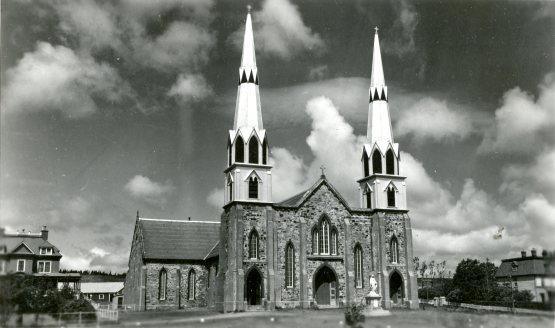
8 Dec. 1868: Immaculate Conception Cathedral dedicated.

Immaculate Conception Church, ca. 1940. Photo courtesy Jane Lynch.
16 Dec. 1868: British Hall on Victoria St opened.
17 Dec. 1890: Slating of the new Immaculate Conception Cathedral completed.
17 Dec. 1894: Robert Stewart Munn dies at Harbour Grace. The death of Robert S. Munn marked the end of an era in the Newfoundland fishery. His estate was declared insolvent and John Munn and Co. went bankrupt in short order. In spring 1895, the firm’s sealing fleet was sold to pay off his creditors, ending the Conception Bay seal hunt. More info: Dictionary of Canadian Biography.
19 Dec. 1766: Laurence Coughlan appears before the SPG and presents a petition from the people of Harbour Grace and vicinity, asking that he be appointed the Society’s missionary and given an annual stipend. By that date he had already resided “some time” among the people as “their Minister.” More info: Dictionary of Canadian Biography.
22 Dec. 1858: The Annual Examination of the Harbour Grace Grammar School takes place. The following prizes are awarded: “For general Excellence Throughout the past year: First Prize to Douglas BROWN; Second prize to T.G. RODDICK; Third prize to Michael DWYER. For Writing: First prize to Douglas BROWN; Second prize to James FOLEY; Third prize to Philip BROWN; Fourth prize to Selby DOW. For Regular Attendance: First prize to Robt. LAWRENCE; Second prize to Michael DWYER; Third prize to William BADCOCK.” More info: Profile: Harbour Grace Grammar School 1845-1902.
26 Dec. 1883: A sectarian riot occurs between Orangemen of Courages Beach and the Roman Catholics of Riverhead. This riot later became known as “The Harbour Grace Affray.”
31 Dec. 1841: A meeting is held at Harbour Grace with John Munn as Chairman, making a strong effort to establish a Steamboat Packet between Harbour Grace and Carbonear, to make daily trips to Portugal Cove.

Pictured: Mummers skating in Harbour Grace, ca. 1910. This picture was taken at the skating rink near the top of Kingswell Lane, visible on early survey maps. The Fruitfield (left) and Braehead (right) can be seen in the background.
Photo courtesy the Conception Bay Museum archives.
(Happy Holidays!)

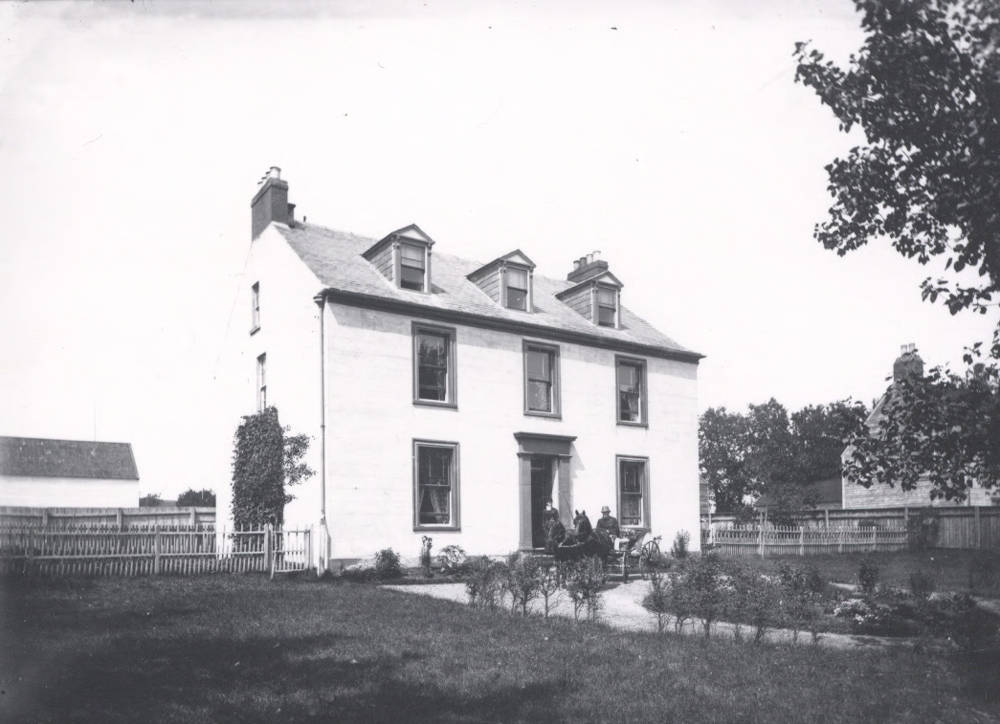
Pictured: Braehead, Harvey St, Harbour Grace, ca. 1910. Braehead was the childhood home of Dr. Roy Goodwin, the town dentist for many years.
Photo courtesy MUN Digital Archives Initiative – Geography Collection.

Pictured: The Greyhurst property, ca. 1910. The home of Dr. William Allan, the Greyhurst was located just directly east of Doctors Lane, a small route connecting Water St and Harvey St, next to the Aero Tennis Club – Newfoundland’s oldest. The lane was presumably named for its proximity to Allan’s home (or, alternatively, to the nearby property of Dr. William Archibald Stirling).
The Soper family purchased the home in the 1954, constructing a service station on Harvey St, directly behind the property. The house was torn down in 1955.
Photo courtesy MUN’s Digital Archives Initiative – Geography Collection.

Pictured: The construction of Coughlan United Church on Water St East, Harbour Grace, 1949. On August 17, 1944, its predecessor burned during the third ‘Great Fire’ of Harbour Grace. This new church would be the fifth Methodist institution in the town’s history. Rev. Walter H. Macabe opened and dedicated the present-day Coughlan United Church on August 29, 1950. More than 1,000 people, including visitors from St. John’s, attended the opening service.
The cemetery in the foreground holds the grave of Rev. William Ellis, the first British Methodist missionary to be buried in Newfoundland. The community of Elliston (formerly Bird Island Cove) takes its name from the Reverend. Nearby, rumours have it Easton buried men killed during a Basque raid in an unmarked mass grave.
Photo courtesy MUN Digitial Archives Initiative / Canada United Church.

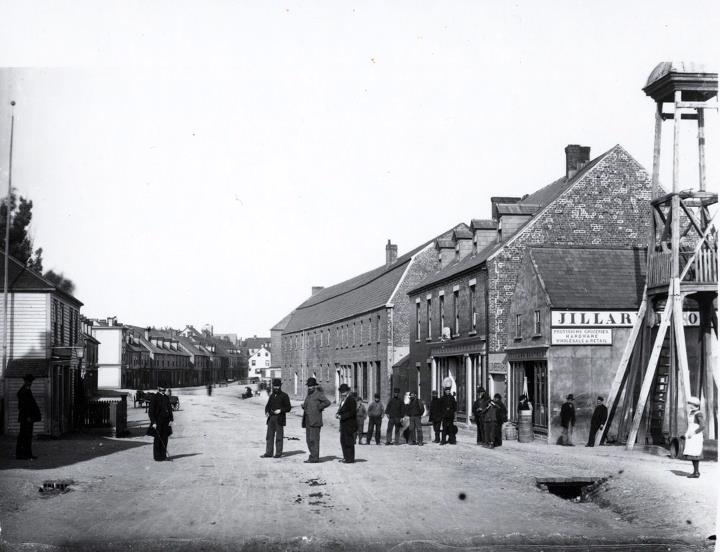
Pictured: Water Street, Harbour Grace, looking east, ca. 1890. Jillard Brothers’ hardware, grocery, and general supply store is pictured on the right, near the fire bell tower.
Photo courtesy of a recent donation to the Conception Bay Museum archives.

Follow the Harbour Grace Notebook series with the hashtag #hgnotebook on Facebook, Twitter and Instagram.
—
1 Nov. 1836: Harbour Grace hit with election violence.
2 Nov. 1870: Thomas Harrison Ridley states in the Harbour Grace Court House to his creditors that he has lost three hundred thousand dollars during the past few years in general trade. A compromise is arranged and strong efforts are made to keep the business going.
4 Nov. 2018: Ceremonial farewell to Immaculate Conception Cathedral.
6 Nov. 1764: Edward Langman writes to Society of the Propagation of the Gospel: “It was my decision, on my return from Trinity, to have paid a visit to Harbour Grace. By reason, the Inhabitants of that place and Carbonear a neighbouring place, and some other Inhabitants of Conception Bay, have later raised a Subscription for Erecting a new Church at Harbour Grace…the Inhabitants, Merchants and Employers of Harbour Grace, Carbonear, Et cet: are very desirous of having a resident of the Missionary to perform Divine Service in, if the worthy Society Shall think proper to Send one among them. I am told there is now a Subscription on foot amongst the people there, for the Support of a Minister, beside what the Society Sh/d allow yearly, in case the Society Sh/d Send one to them.”
8 Nov. 1889: Second Immaculate Conception Cathedral dedicated.
8 Nov. 1997: Gordon G. Pike Railway Museum & Heritage Park opened in Harbour Grace.
13 Nov. 1822: Advertisement in The Newfoundland Patriot: “The Packet boat Lively sails twice a week from Portugal Cove to Harbor Grace. Fare: Ladies & Gentlemen: 5 shillings each; Tradesmen & Laborers: 4 shillings each; Hire of boat: 30 shillings; Letters: 9 pence.”
13 Nov. 1886: St. Joseph’s Church opens in Riverhead.
15 Nov. 1836: Violence against Joseph Pippy in Mosquito, related to assault of Thomas Ridley.
16 Nov. 1859: Harbour Grace Standard first published in Harbour Grace.
16 Nov. 1886: Cornerstone of the former St. Paul’s Hall on Harvey St laid.
19 Nov. 1846: Enrico Carafagnini ordained a Roman Catholic priest.
20 Nov. 1883: The Bonnie Lass, a Harbour Grace schooner, sinks near Pouch Cove. Captain D. Hogan, mate John Leary, and steward M. Lahey drown.
21 Nov. 1837: Harbour Grace Island lighthouse first exhibited. Austin Oke is its first light keeper.

Harbour Grace Island Lighthouse (Source: Maritime History Archive)
22 Nov. 1765: People of Harbour Grace and Carbonear authorize merchant George Davis to obtain a Protestant clergyman for the area; that priest would be Laurence Coughlan.
22 Nov. 1884: First train runs over the branch line from St. John’s to Harbour Grace.
24 Nov. 1851: Frederick N. Gisborne, engineer of Manchester, England, completes telegraph line from St. John’s to Harbour Grace.
26 Nov. 1612: After successful lobbying by Sir Richard Whitbourne, King James I grants a second pardon to Peter Easton. The pardon never reaches the pirate.
27 Nov. 1921: First telephone connection made between St. John’s and Harbour Grace.