Harbour Grace Notebook: December

Old_book_bindings

Follow the Harbour Grace Notebook series with the hashtag #hgnotebook on FacebookTwitter and Instagram

2 Dec. 1779: Rev. James Balfour, Anglican minister at Harbour Grace, writes to Society for the Propagation of the Gospel (SPG): “A raging Famine, Nakedness, & Sickness in these parts. None can experience the heartfelt woe of Women & Children mourning for want of Food.” More info: Dictionary of Canadian Biography.

2 Dec. 1904: Enrico Carafagnini dies in his hometown of Aversa, Italy, while visiting his nephew. More info: Dictionary of Canadian Biography.

4 Dec. 1931: An early morning fire of alarming proportions rages in Harbour Grace. Fire totally destroys the store of William Babb and Sons, formerly owned by Andrew Rutherford, and the stone house of Timothy Hayden, in which a Mrs. Woods and her family live. More info: “The Forgotten Fire,” by Gord Pike.

7 Dec. 1852: Rutherfords open a spacious new shop.

8 Dec. 1868: Immaculate Conception Cathedral dedicated.
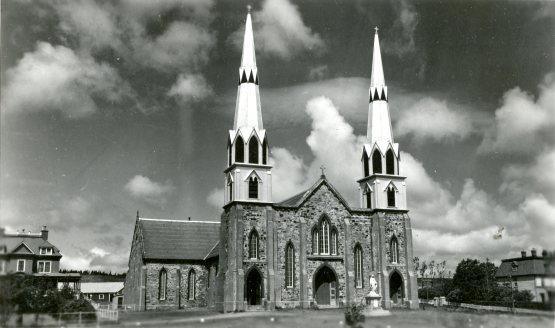
Immaculate Conception Church

Immaculate Conception Church, ca. 1940. Photo courtesy Jane Lynch.

16 Dec. 1868: British Hall on Victoria St opened.

17 Dec. 1890: Slating of the new Immaculate Conception Cathedral completed.

17 Dec. 1894: Robert Stewart Munn dies at Harbour Grace. The death of Robert S. Munn marked the end of an era in the Newfoundland fishery. His estate was declared insolvent and John Munn and Co. went bankrupt in short order. In spring 1895, the firm’s sealing fleet was sold to pay off his creditors, ending the Conception Bay seal hunt. More info: Dictionary of Canadian Biography.

19 Dec. 1766: Laurence Coughlan appears before the SPG and presents a petition from the people of Harbour Grace and vicinity, asking that he be appointed the Society’s missionary and given an annual stipend. By that date he had already resided “some time” among the people as “their Minister.” More info: Dictionary of Canadian Biography.

22 Dec. 1858: The Annual Examination of the Harbour Grace Grammar School takes place. The following prizes are awarded: “For general Excellence Throughout the past year: First Prize to Douglas BROWN; Second prize to T.G. RODDICK; Third prize to Michael DWYER. For Writing: First prize to Douglas BROWN; Second prize to James FOLEY; Third prize to Philip BROWN; Fourth prize to Selby DOW. For Regular Attendance: First prize to Robt. LAWRENCE; Second prize to Michael DWYER; Third prize to William BADCOCK.” More info: Profile: Harbour Grace Grammar School 1845-1902.

26 Dec. 1883: A sectarian riot occurs between Orangemen of Courages Beach and the Roman Catholics of Riverhead. This riot later became known as “The Harbour Grace Affray.”

31 Dec. 1841: A meeting is held at Harbour Grace with John Munn as Chairman, making a strong effort to establish a Steamboat Packet between Harbour Grace and Carbonear, to make daily trips to Portugal Cove.

Photo of the Day: Greyhurst, ca. 1910

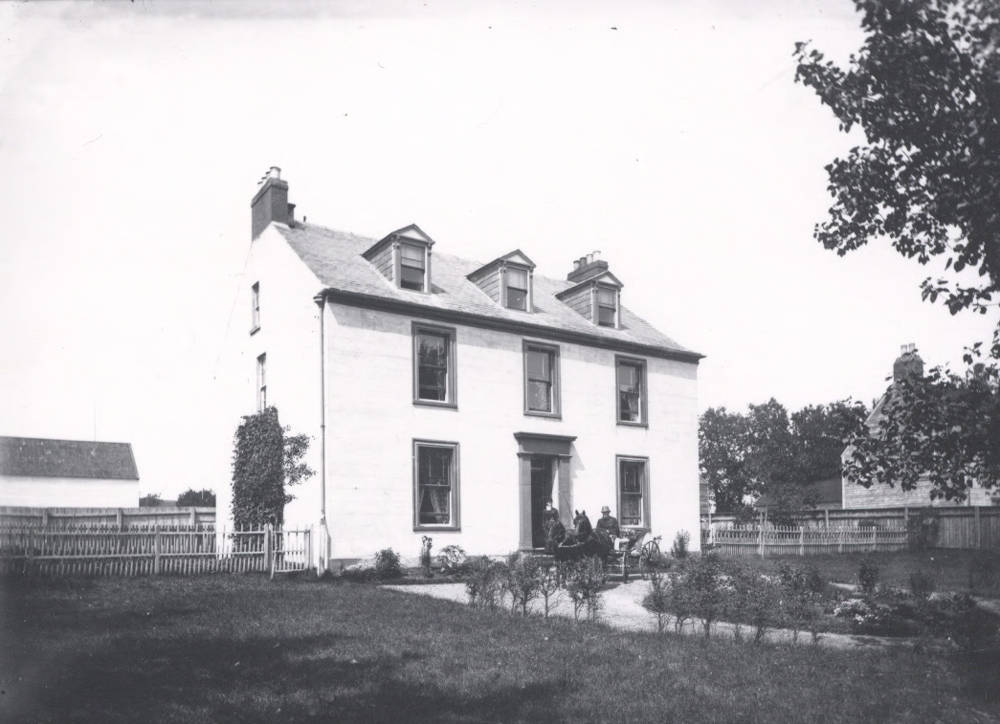
GREYHURST1

Pictured: The Greyhurst property, ca. 1910. The home of Dr. William Allan, the Greyhurst was located just directly east of Doctors Lane, a small route connecting Water St and Harvey St, next to the Aero Tennis Club – Newfoundland’s oldest. The lane was presumably named for its proximity to Allan’s home (or, alternatively, to the nearby property of Dr. William Archibald Stirling).

The Soper family purchased the home in the 1954, constructing a service station on Harvey St, directly behind the property. The house was torn down in 1955.

Photo courtesy MUN’s Digital Archives Initiative – Geography Collection.

Photo of the Day: Constructing Coughlan United, 1949

WY500_610_Harbour_Grace

Pictured: The construction of Coughlan United Church on Water St East, Harbour Grace, 1949.  On August 17, 1944, its predecessor burned during the third ‘Great Fire’ of Harbour Grace. This new church would be the fifth Methodist institution in the town’s history. Rev. Walter H. Macabe opened and dedicated the present-day Coughlan United Church on August 29, 1950. More than 1,000 people, including visitors from St. John’s, attended the opening service.

The cemetery in the foreground holds the grave of Rev. William Ellis, the first British Methodist missionary to be buried in Newfoundland. The community of Elliston (formerly Bird Island Cove) takes its name from the Reverend. Nearby, rumours have it Easton buried men killed during a Basque raid in an unmarked mass grave.

Photo courtesy MUN Digitial Archives Initiative / Canada United Church.

Harbour Grace Notebook: November

book-1941299_1280-e1497905055505

Follow the Harbour Grace Notebook series with the hashtag #hgnotebook on FacebookTwitter and Instagram

1 Nov. 1836: Harbour Grace hit with election violence.

2 Nov. 1870: Thomas Harrison Ridley states in the Harbour Grace Court House to his creditors that he has lost three hundred thousand dollars during the past few years in general trade. A compromise is arranged and strong efforts are made to keep the business going.

4 Nov. 2018: Ceremonial farewell to Immaculate Conception Cathedral.

6 Nov. 1764: Edward Langman writes to Society of the Propagation of the Gospel: “It was my decision, on my return from Trinity, to have paid a visit to Harbour Grace. By reason, the Inhabitants of that place and Carbonear a neighbouring place, and some other Inhabitants of Conception Bay, have later raised a Subscription for Erecting a new Church at Harbour Grace…the Inhabitants, Merchants and Employers of Harbour Grace, Carbonear, Et cet: are very desirous of having a resident of the Missionary to perform Divine Service in, if the worthy Society Shall think proper to Send one among them. I am told there is now a Subscription on foot amongst the people there, for the Support of a Minister, beside what the Society Sh/d allow yearly, in case the Society Sh/d Send one to them.”

8 Nov. 1889: Second Immaculate Conception Cathedral dedicated.

8 Nov. 1997: Gordon G. Pike Railway Museum & Heritage Park opened in Harbour Grace.

13 Nov. 1822: Advertisement in The Newfoundland Patriot: “The Packet boat Lively sails twice a week from Portugal Cove to Harbor Grace. Fare: Ladies & Gentlemen: 5 shillings each; Tradesmen & Laborers: 4 shillings each; Hire of boat: 30 shillings; Letters: 9 pence.”

13 Nov. 1886: St. Joseph’s Church opens in Riverhead.

15 Nov. 1836: Violence against Joseph Pippy in Mosquito, related to assault of Thomas Ridley.

16 Nov. 1859: Harbour Grace Standard first published in Harbour Grace.

16 Nov. 1886: Cornerstone of the former St. Paul’s Hall on Harvey St laid.

19 Nov. 1846: Enrico Carafagnini ordained a Roman Catholic priest.

20 Nov. 1883: The Bonnie Lass, a Harbour Grace schooner, sinks near Pouch Cove. Captain D. Hogan, mate John Leary, and steward M. Lahey drown.

21 Nov. 1837: Harbour Grace Island lighthouse first exhibited. Austin Oke is its first light keeper.

Harbour Grace Lighthouse

Harbour Grace Island Lighthouse (Source: Maritime History Archive)

22 Nov. 1765: People of Harbour Grace and Carbonear authorize merchant George Davis to obtain a Protestant clergyman for the area; that priest would be Laurence Coughlan.

22 Nov. 1884: First train runs over the branch line from St. John’s to Harbour Grace.

24 Nov. 1851: Frederick N. Gisborne, engineer of Manchester, England, completes telegraph line from St. John’s to Harbour Grace.

26 Nov. 1612: After successful lobbying by Sir Richard Whitbourne, King James I grants a second pardon to Peter Easton. The pardon never reaches the pirate.

27 Nov. 1921: First telephone connection made between St. John’s and Harbour Grace.

Curator’s Report Excerpt: Attendance at a Glance (2019)

On behalf of our museum, we would like to share a portion of our Curator’s Final Report
for this tourist season (2019). We have had a very successful season, as the attendance
numbers below demonstrate:


attendance1

Non-resident museum visitors (2019)

attendance2

Museum visitors from NL (2019)

attendance3

Museum visitors from other parts of Canada (2019)

attendance4

Museum visitors from the United States (2019)

attendance5

Museum visitors from Europe & Australia (2019)

attendance6

Total attendance (2019)

attendance7

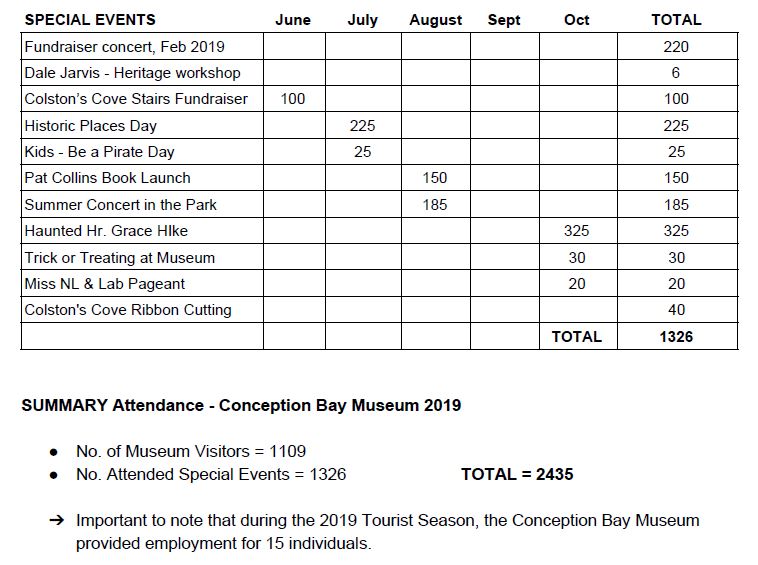
Special events breakdown (2019)

To conclude, the Conception Bay Museum has had a wonderful tourist season. Our
summer student tour guides performed exceptionally as they welcomed visitors from
all over the world daily. Our Board of Directors is to be commended for their hard work
and dedication to our museum – they go above and beyond! And most importantly, we
would like to thank ALL who have contributed to and supported our museum in any way. We appreciate it so much – our beautiful historic building by the sea wouldn’t exist
without you! See you in the spring!

Download this excerpt of the Curator’s report here [PDF].

– Curator’s report and statistics by Danita Power 

Video: Profile of the Conception Bay Museum

On Saturday, November 9, the Conception Bay Museum’s latest tourism infrastructure project, the redesigned stairs to Colston’s Cove, were opened to the public in Harbour Grace. The Harbour Grace Board of Culture, Innovation & Business’ oral history research team were on hand to capture the opening and chat to locals about what the Museum means to the community. Check out the video below:

For future updates on the oral history series, visit the Harbour Grace Board of Culture, Innovation and Business’ Facebook and YouTube pages.

Thanks to Alyssa Shaw, Ryan Reynolds, Andrew Rossiter and Jo-Annah Yetman for the video.


Artifact Profile No. 5: Red Ensign

IMG_3640

Thank you to Joy French-Coleman for donating this beautiful historic flag, the Red Ensign, to the Museum at our AGM on Thursday, November 14, 2019. This flag belonged to Joy’s parents, Gordon and Mary French, who once owned Victoria Manor.

The Red Ensign was officially endorsed by King Charles II in 1674; this authorization recognized it as the ensign of English merchant shipping. Later, during the Victorian era, the flag—with colonial badge—formed the basis as the Colony of Newfoundland’s civil ensign. Old oil paintings show red ensigns flying from the topmasts of Grand Banks schooners. Nineteenth-century photographs show red ensigns flown at Moravian mission stations and Hudson’s Bay Company trading posts along the Labrador Coast.

Red Ensign (Newfoundland)

Red Ensign (Newfoundland). Photo courtesy Wikipedia Commons.

In 1904, the British Parliament designated a civil ensign specifically for Newfoundland. The Red and Blue Ensigns with the Great Seal of Newfoundland in the fly were the British Dominion’s colony’s official flags from 1904 until 1931, after which the Union Jack was adopted as Newfoundland’s official national flag and the ensigns reserved for shipping and marine identification—the Red Ensign to be flown by merchant shipping while the blue was flown by governmental ships. Neither ensign was immediately formally adopted by the Newfoundland National Assembly, which sat at the Colonial Building in St. John’s, when Newfoundland became an independent Dominion of the British Empire in 1907. It was not until the Newfoundland National Flag Act of 1931 that the Newfoundland parliament officially adopted the Union Jack as the national flag of Newfoundland and re-affirmed the red and blue ensigns as official flags for marine identification. Between 1907 and 1931, however, the red ensign gained wide enough use, both at sea and on land by civilians and government alike, that it was considered to be the national flag.

The badge in the ensigns consists of Mercury, the god of commerce and merchandise, presenting to Britannia a fisherman who, in a kneeling attitude, is offering the harvest of all the sea. Above the device in a scroll are the Latin words ‘Terra Nova‘, and below the motto Hæc Tibi Dona Fero or “These gifts I bring thee.” The seal was redesigned by Adelaine Lane, niece of Governor Sir Cavendish Boyle.