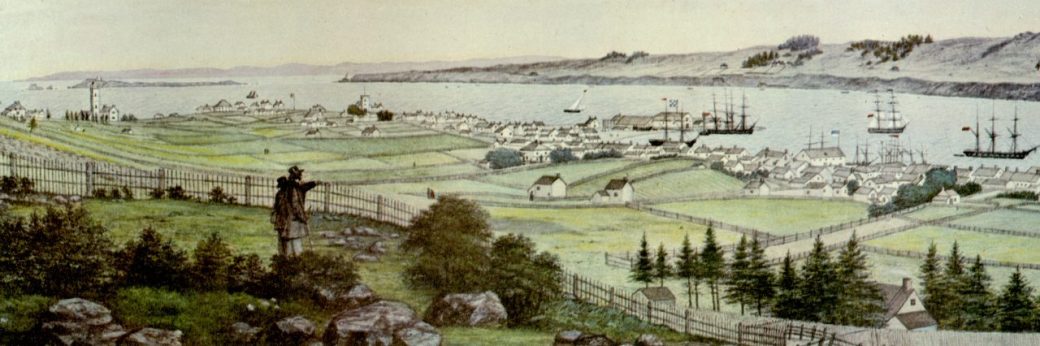
Photo of the Day: “Harbour Grace, 1841,” by William Gosse

cropped-img475-1.jpg

Pictured: “Harbour Grace, 1841,” a panoramic sketch by William Gosse (signed W. Gosse). Landmarks in this picture include the first Roman Catholic Church in Harbour Grace, with its 100-foot steeple, built by Rev. Thomas Ewer (Yore); the community’s stone courthouse, a National Historic Site built in 1832; Garrison House (Hampshire Cottage), Registered Heritage Structure; the stone St. Paul’s Church, a Registered Heritage Structure built in 1835; the first Customs House, a wooden-thatch roofed structure; the Methodist parsonage;  and the Point of Beach, with its attendant schooners in the harbour.

Gosse’s sketches can be found at the Provincial Archives (The Rooms) in St. John’s. Other sketches include Ship Cove (Port de Grave) and that of a Beothuk woman in 1841.

Print courtesy the Conception Bay Museum archives; donated by former MHA Hon. Haig Young, former Minister of Public Works and Transportation.

Download in high quality (1200 dpi) here: Google Drive

Event: Storytelling & Recitations with Pat Collins & Aiden Moriarty

7776E3BC-71E8-4C55-AEB9-3CB744C0FB41 (1)

Event: Storytelling and Recitations with Pat Collins & Aiden Moriarty (2020 Annual Winter Carnival)

Date: Tuesday, February 18, 2020

Time: 7:00 p.m.

Location: Admiral’s Marina, Harbour Grace South, NL

Tickets: This is a free event. However, due to limited seating, a ticket is required. Tickets are available at the Town Hall, 112 Water St, Harbour Grace, during opening hours, 8:30 a.m. – 4:30 p.m.

Calendar Fundraiser: Call for Photos

calendar1

2021 Conception Bay Museum Calendar Fundraiser:

The Conception Bay Museum Board of Directors is compiling a collector’s calendar for the 2021 year depicting “Historic Harbour Grace.” It is a fundraising project to help with our museum’s operational costs.

If you own or have the rights to any original photographs of Harbour Grace before 1949 (pre-Confederation) and would like to offer them for consideration to be used in our calendar, please email them before February 21, 2020. The photographs should be of buildings or events of historic value and not have recognizable people. You will be given credit for your photograph if it is used. Email your photo to: conceptionbaymuseum@outlook.com.

Thank you,

Conception Bay Museum Board of Directors

Artifact Profile No. 6: Showcase from Parsons General Store (Fanny’s)

IMG_4279

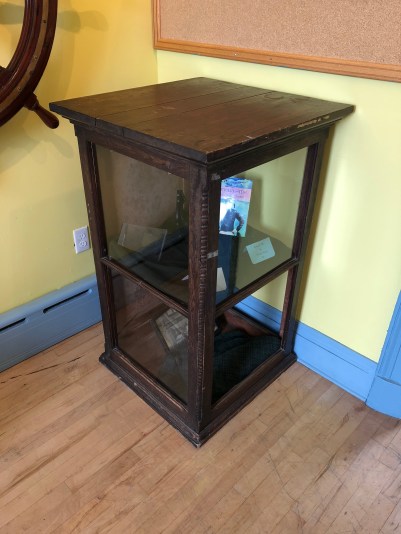
This showcase is dated to 1928, when it first stood in Parsons General Store on Water St, Carbonear, a shop more commonly known as Fanny’s. Alma Parsons donated this showcase to the Museum in memory of her husband and father-in-law. Today, the Museum uses this showcase to display artifacts and gift shop items.

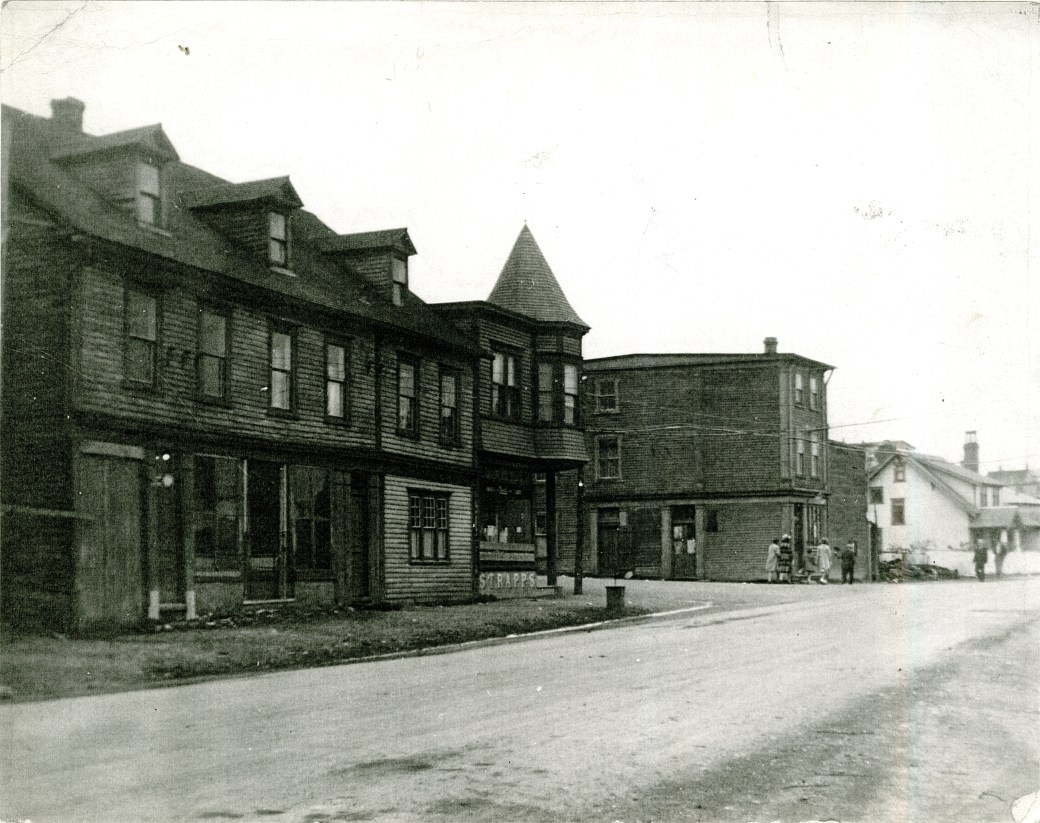
Parsons General Store

Parsons General Store (Fanny’s). Photographer unknown.

The store was owned by Mark Parsons Sr (1884-1965) and his wife Fanny (Marshall) Parsons (1884-1970). A fisherman, Mark often mended his nets in the shop while Fanny served customers. According to the donation slip, the showcase housed “block cheese on one shelf and bologna on another,” items which Fanny carved with a large knife. The large front window on the right hand side of the shop was a great attraction for children, who would be tempted inside by the vast display of delights–Jaw Breakers, Barrel Candy, Sugar Daddies, Caravan Bars, twelve-cent cakes, and large Marshmallow Squares–on their way to and from school. The shop was perfectly located between Church Hill and Captain Frank’s Lane on the water side of Water St. Children would even make the dash to Fanny’s at recess, to get their fill of delectable sweets or a slice of bologna. For a grand total of twenty-five cents in the 1950s and ’60s, you could get a bag of Scotties Chips and a bottle of drink, with a few candy to boot.

Fanny (Marshall) Parsons

Fanny (Marshall) Parsons, 1884-1970.

Fanny is remembered as a kind, gentle lady who operated the shop well into her 80s. Her daughter-in-law Alma Parsons (1921-2013), wife of Mark Parsons Jr, ran the shop when Fanny could no longer manage. Many happy childhood memories have been shared about Fanny, some from young men who would stop in on their way uptown on a Friday night for cigarettes, or to warm up by the potbelly stove in winter.

Fanny’s represents a bygone era of Carbonear–gone but not forgotten.

– Research and writing courtesy of Danita Power and Anne Gosse. 


Harbour Grace Notebook: January

photo-1447023029226-ef8f6b52e3ea

Follow the Harbour Grace Notebook series with the hashtag #hgnotebook on FacebookTwitter and Instagram

2 Jan. 1841: Magistrate’s Report: Dr. William Stiring’s son threatened by a man with a stick, who rushed out of the woods on Saddle Hill in late December.

4 Jan. 1709: First English account of the capture of St. John’s by the French:

“Letter from H.E. Harbargrace Island, 4 Jany 1709: ‘On the 21st December, the French from Placentia to the number of one hundred sixty came to the fort of St. John’s and there were scaling ladders got over the work without any assistance, only two small guns the sentry fired; Major Lloyd then asleep in his bed and after the French got into the fort, the inhabitants in the new fort arose in arms and would have taken the fort again from the French, but the soldiers could not get the keys out of the Major’s House; but when the French came he could find them; so from some of these men that made their escapes to those islands Harbargrace and Carboniere; the fort was actually sold to the French or else that number could have never taken it. They surrendered the Castle the next day being never an officer to command it.'”

5 Jan. 1832: Notice posted by sealers to meet at Saddle Hill and discuss grievances. More info: Perseverance: The Sealers’ Strike in Harbour Grace & Carbonear, 1932

5 Jan. 1870: Elfreda Pike murdered on Mosquito Hill, Harbour Grace. More info: Murder at Mosquito Cove by Patrick J. Collins.

6 Jan. 1870: Body of Elfreda Pike discovered on Mosquito Hill, Harbour Grace. 

7 Jan. 1834: Peter Downing hanged on Market House Hill, St. John’s, for the murders of Robert Crocker Bray, Samuel Comer Bray and Ellen Coombs. More info: Archival Moments / Gibbet Hill: Unfinished Justice by Patrick J. Collins

8 Jan. 1884: Chief Constable John Doyle arrested for the murder of Patrick Callahan during the Harbour Grace Affray. More info: Archival Moments / Harbour Grace Affray by Patrick J. Collins.

9 Jan. 1832: Meeting convened at Saddle Hill between striking sealers of Harbour Grace and Carbonear. 2,000-3,000 men are there with fifes. The men christen Saddle Hill “Liberty Hill.” More info: Perseverance: The Sealers’ Strike in Harbour Grace & Carbonear, 1932

10 Jan. 2006: Bennett’s Lane Roman Catholic Cemetery designated a Municipal Heritage Site. More info: Bennett’s Lane Roman Catholic Cemetery.

12 Jan. 1860: Gas House on LeMarchant St destroyed by fire. 

16 Jan. 1924: Presbyterians in Harbour Grace discuss the question of cooperation with the Methodist congregation there but vote against it. More info: A History of the Presbyterian Church in Newfoundland by Wilfred A. Moncrieff.

18 Jan. 1880: Sir Richard Squires born at Harbour Grace. More info: Dictionary of Canadian Biography.

22 Jan. 1852: Barque Rothesay first launches at Harbour Grace. More info: Profile: Michael Condon Kearney and the Rothesay.

24 Jan. 1885: The first privately owned rink in Harbour Grace opens at the junction of Harvey St and Cochrane St. It was 117 feet in length and 53 feet in width. The property was owned by Daniel J. Green, a prominent businessman who was a coal dealer, merchant and sealer, whose business premises were at 137 Water St.

25 Jan. 1697: Pierre Le Moyne D’Iberville takes three settlers and a “Trembladaise religionnaire” prisoner at Harbour Grace. The “Trembladaise religionnaire” was presumably a religious man from La Tremblade, a small Protestant fishing port on the Avert Peninsula, in the estuary of the River Sendre, near Rochefort. These men were all likely Huguenots, whose fate would have been precarious under the capture of these Catholic men. More info: Father Baudoin’s War by Allan T. Williams.

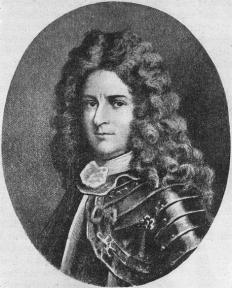
Pierre Le Moyne D'Iberville

Pierre Le Moyne D’Iberville, 1661-1706

27 Jan. 1864: Ridley & Sons ship 6,100 quintals of codfish on board the Spanish brig Amelia, one of the largest cargoes ever shipped from Harbour Grace. 

27 Jan. 1877: Samuel Gordon, owner of Gordon Lodge, dies.

28 Jan. 1697: D’Iberville burns Harbour Grace; there were fourteen families there, with many cattle in their barns. Father Baudoin, who accompanied D’Iberville on his raids, notes that “a settler died here three years ago who had been born in the place. His age was 83 years.” More info: Father Baudoin’s War by Allan T. Williams.

28 Jan. 1905: Fourth Methodist church opened and dedicated by Rev. James Pincock.

29 Jan. 1857: Meeting at Temperance Hall to petition House of Assembly to erect a lighthouse on “Baccaloo” (presumably Baccalieu Island).

Profile: Bennett’s Lane Roman Catholic Cemetery

bennetts-lane-2005-1 (1)

The Bennett’s Lane Cemetery is the oldest Roman Catholic graveyard in Harbour Grace.

The oldest known gravestone can be traced to 1802, though there were burials here in the late eighteenth century.

Most notably, Father Patrick Phelan is buried at Bennett’s Lane Cemetery, Harbour Grace. Phelan, a Franciscan or Friar Minor, headed the Harbour Grace mission under Bishop James O’Donel (O’Donnell), travelling around Conception Bay to deliver mass to its Catholics. Although the date of his arrival is unknown, Phelan was in Harbour Grace by 1794, making two visitations to his parish annually. In September 1799, Phelan drowned off Grates Cove, his boat capsizing along with its crew. Phelan’s body was recovered and interned at the only Catholic graveyard in Harbour Grace. Rev. Thomas Ewer (Yore), who oversaw the construction of Harbour Grace’s first church – a wooden structure with a 100-foot steeple – was also said to be buried at Bennett’s Lane Cemetery in 1833. By 1856, the graveyard was no longer used.

On January 10, 2006, the Bennett’s Lane Roman Catholic Cemetery was designated a Municipal Heritage Site by the Town of Harbour Grace.

With headstones almost completely eroded by time and weather, this ancient burial ground still commands respect and an air of reverence. Huge markers reveal weathered, elaborate homages to those interred in the cemetery grounds, but today they stand precariously among the uneven ground. The size of the headstones and their shapes and designs reveal the importance placed on this cemetery by the Roman Catholic community of nineteenth century.
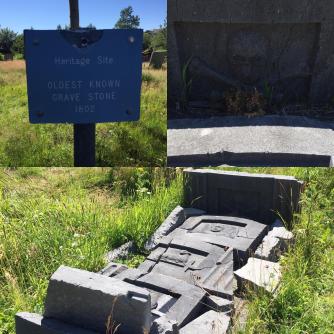
bennet

In recent years, this graveyard has garnered interest, due to mysterious skull-and-crossbones iconography on a tom

bstone. In 2013 the Knights of Columbus Dalton Council No. 1448 rediscovered this grave during a cleanup of the site. Though there are many theories about its origins, nothing has been proven conclusively. In all likelihood, the grave holds a young child, possibly a cholera victim. The lamb iconography probably symbolizes a young victim, the skull-and-crossbones signifying some form of infectious hazard.

The most popular, contentious theory is that the gravesite is a “pirate’s grave,” the final resting place of nineteenth-century pirate John Keating, of Harbour Grace. Local historian Jack Fitzgerald popularized this story his books Treasure Island Revisited (2005) and Remarkable Stories of Newfoundland (2010). A Telegram article details Fitzgerald’s theory:

The identity of the remains in a grave at Harbour Grace displaying the pirate’s skull and crossbones might never be known, but there is a possibility that it’s the resting place of Capt. John Keating.

He is the most internationally famous of all Newfoundland pirates.

Keating was born in Harbour Grace in 1808 and died at St. John’s in 1882.

While two sons of Harbour Grace are mentioned in the many books on “The Lost Treasure of Lima” — also known as “The Cocos Island Treasure” — Keating is the one who found the treasure in 1841 and again in 1845.

The treasure was originally pirated in 1821 by Capt. William Thompson from the port of Callao, Peru, and buried on Cocos Island.

The second person was Capt. Nick Fitzgerald from Riverhead, Harbour Grace.

He was given the map by Keating (about 25 years later), and after Keating’s death, made a deal with adventurer Herve Montmorency to give him the map in return for five per cent of the treasure.

At today’s value, the treasure is estimated to be worth $350 million.

Of the two Harbour Grace natives, the one most likely to have a grave marked with the sign of a pirate is Keating.

After finding the treasure and returning to St. John’s — twice — with parts of the hidden Lima treasure, Keating bragged about his success so much that towns-people nick-named him “Keating of the Cocos.”

When he first met Fitzgerald, he boasted, “I am known in St. John’s as Keating of the Cocos.”

In fact, Rupert Furneaux, author of “The Great Treasure Hunt,” claimed, “From John Keating has descended the fundamental Cocos Legend which is accepted by all modern Treasure Hunters.”

It was Keating’s successful expedition in 1841 that set off a treasure hunt craze that continues to this day. Nobody goes in search of that treasure without researching Keating.

In 2012, German filmmaker Dr. Ina Knobloch — with whom I worked on earlier documentaries on this treasure — teamed up with a British industrialist on a treasure-hunting expedition.  

The Montmorency Expedition failed and Fitzgerald died in 1905.

I located Fitzgerald’s grave, but had no success in making an absolute finding of Keating’s grave.

Up till now I believed that he was buried with his first wife and child in the family grave at Belvedere in St. John’s. Yet, his name is not on the tombstone, so I cannot be certain he is buried there.

Montmorency published a book on his expedition. It created a sensation here due to the Newfoundland connections.

The Lima treasure was originally stolen by British-born Capt. William Thompson and, after burying it on Cocos Island, he returned several times to retrieve portions of it.

While trying to evade authorities, he crossed over Mexico and ended up in Metanzas, Cuba, where he met Keating. Thompson jumped at the opportunity to join Keating as a crewman on his return to Newfoundland.

In St. John’s, Thompson boarded with Keating’s mother two doors east of Prescott Street. Keating and the pirate soon became friends.

They turned to Capt. Billy Boig, whose residence was on George Street, to plan a major expedition to retrieve all the treasure. This expedition ran into problems, Thompson died and Boig was murdered. Keating found the treasure, did not tell the crew, and took as much as he could carry back to Newfoundland.

Keating displayed during his lifetime the kind of ego that would prompt him to immortalize his connection to one of the world’s greatest pirate stories with a skull and crossbones marking his grave.

After Fitzgerald’s article and the cleanup, interest in the graveyard spiked for locals and tourists alike.

From 1993-95, a group of students recorded the 42 graves for posterity. The listing can be viewed here. Alternatively, Newfoundland Grand Banks has an active database of the Bennett’s Lane Cemetery records.

— Republished from hrgrace.ca.

Harbour Grace Notebook: July

photo-1475243907012-e01b4e4b0a1b

Follow the Harbour Grace Notebook series with the hashtag #hgnotebook on FacebookTwitter and Instagram

1 July 1851: First Presentation Sisters arrive in Harbour Grace.

1 July 1867: Cornerstone laid on Masonic Lodge by A.W. McKay. Still standing, the Lodge is the oldest in Newfoundland and the oldest wooden Masonic Lodge in Canada. More info: Heritage Foundation of NL.

4 July 1840: Bishop Aubrey Spencer officially consecrates St. Paul’s Church. More info: St. Paul’s Anglican Church.

4 July 1919: Handley Page Atlantic leaves Harbour Grace. More info: “Great Atlantic Air Race: Admiral Kerr in Harbour Grace,” by Dr. Lisa M. Daly.

5 July 1932: Century of Progress aircraft, piloted by Jimmy Matern and Bennett Griffin, arrives in Harbour Grace; leaves for Berlin, Germany, the same day

5 July 1919: Handley Page Atlantic forced to crash land at Parrsboro, Nova Scotia, after leaving Harbour Grace; the crew repaired the plane over the summer. “Great Atlantic Air Race: Admiral Kerr in Harbour Grace,” by Dr. Lisa M. Daly.

Handley Page Atlantic crashes at Parsboro, NS

Handley Page Atlantic crashes at Parrsboro, NS

6 July 1829: Governor Sir Thomas Cochrane visits Harbour Grace to select a site for the new courthouse. He chooses the site where the courthouse is today. There is some suggestion that the courthouse should be built further west on Harvey St. More info: Harbour Grace Courthouse.

6 July 1860: Harbour Grace Volunteer Regiment forms. To approve the volunteer militia, a letter is sent to Magistrate Robert John Pinsent and signed by Captain John Hayward; Lieut. Henry T. Moore, and Robert Stewart Munn. The Regiment drilled at the Parade Grounds, near Military Rd, when weather permits, or at the Barracks. Rifle practice took place west of Target Hill, near Lady Lake.

9 July 1832: A meeting is held to discuss the best way of averting cholera from Harbour Grace. The group pass a resolution to start a subscription for the purposes of a hospital.

9 July 1837: St. Paul’s Church officially opens its doors. More info: St. Paul’s Anglican Church.

9 July 1860: Magistrate Robert John Pinsent sends letter allowing the formation of the Regiment and use of the Barracks. Sergeant Lucas Fallon, chief of police, is tasked with drilling the regiment.

Sergeant Lucas Fallon

Sergeant Lucas Fallon, 1817-1879

10 July 1945: Town of Harbour Grace becomes an incorporated municipality.

11 July 1883: Robert Crocker Bray, Samuel Comer Bray, and Ellen Coombs murdered at the Bray residence, near Church Path/Church Hill (Cochrane St). Bray’s plantation labourers, Peter Downing and Patrick Malone, are arrested for the killings. More info: Archival MomentsGibbet Hill: Unfinished Justice by Patrick J. Collins.

13 July 1863: John March, future Bishop of Harbour Grace Diocese, born in Northern Bay. More info: Newfoundland Grand Banks.

13 July 1931: Justice for Hungary aircraft, piloted by Gyorgy Endresz and Alex Magyar, arrives in Harbour Grace.

14 July 1883: Funerals held for Robert Crocker Bray, Samuel Comer Bray and Ellen Coombs. More info: Archival MomentsGibbet Hill: Unfinished Justice by Patrick J. Collins.

15 July 1931: Justice for Hungary aircraft leaves for Budapest, Hungary.

16 July 1826: King grants Sir Henry Pynn his royal license and permission to wear the insignia of a Knight Commander of the Royal Portuguese Army.

17 July 1799: George Gordon Cawley, a Newfoundland Regiment officer stationed in Harbour Grace, dies. His gravesite in St. Paul’s Anglican cemetery, Harbour Grace, is the oldest known gravesite of a Newfoundland Regiment officer. More info: St. Paul’s Anglican Church.

George Gordon Cawley

Gravesite of Lieut. George Gordon Cawley

20 July 1879: Tender posted in the Harbour Grace Standard: “The Building Committee of the Benevolent Irish Society will receive sealed tenders until Saturday, 28th instant, at noon, from persons wishing to contract for the erection of St. Patrick’s Hall. Plan and specifications can be seen on the application to the application to the Chairman. The Committee do not bind themselves to accept the lowest or any tender. Michael J. Jones, Chairman, Building Comittee.” St. Patrick’s Hall would be constructed near the bottom of Kingswell Lane, directly to the west.

“Movies were held at St. Patrick’s Hall in the town. Those were the days of the silents, in the early decades of the century. The feature pictures were usually western thrillers, but for many of the happy patrons, especially the youth, the main attraction was Charlie Chaplin. The admission was 10 cents for adults and 5 cents for other – and others tended to be legion!” – R.J. Connelly

22 July 1862: First Regatta held at Lady Lake (or Lady Pond), Harbour Grace.

25 July 1927: Harbour Grace Airport Trust Company, a 21-person committee, formed at the Town Hall.

25 July 1929: Bluenose aircraft, piloted by Vernon Darrell, arrives in Harbour Grace on a pleasure cruise.

27 July 1844: Dr. Edward Feild, lord bishop of the Church of England diocese, arrives at Harbour Grace in the packet Victoria. He preaches to a crowded congregation in St. Paul’s Church on the following morning (Sunday), and in the afternoon proceeds to Carbonear, returning to Harbour Grace for evening service. He raises 70 pounds for the Parsonage House soon to be erected in the parish.

27 July 1853: Work begins on the first public wharf in Harbour Grace, at the bottom of Victoria St.

27 July 1929: Bluenose leaves Harbour Grace for Sydney, Nova Scotia.

28 July 1835: Cornerstone laid for new Episcopal Church in Harbour Grace (St. Paul’s).

28 July 1904: Cornerstone laid for fourth Methodist church of Harbour Grace.

29 July 1933: “Bellanca aircraft,” piloted by George Pond, arrives in Harbour Grace.

29 July 1867: Letter in the Harbour Grace Standard: “I see by the ‘Supply’ Act of 1867 that the Legislature granted the sum of $6,000 for the erection of a Customs House in Harbour Grace. It is high time that the said building be commenced – even supposing a piece of land for the site thereof had to be purchased, the above handsome grant would be quite sufficient therefore, and for the erection of the building. If this not be done, we may well fear that the present contracted old crumbling apology for a Custom House will, before long, fall down…” More info: About Us: Customs House.

30 July 1934: “Pleasure cruise aircraft,” piloted by Paul Beso, arrives in Harbour Grace.

30 July 1846: Sir Thomas Roddick born at Harbour Grace, son of John Irving Roddick and Emma Jane Martin. More info: Dictionary of Canadian Biography.