Profile: Second Harbour Grace Methodist Church, 1822-1850

Screen Shot 2019-02-07 at 1.08.44 PM

Built between 1820-23, the Harbour Grace Methodist Church replaced John Stretton’s first Methodist church, built on the hillside which now bears his name. Following the accepted style of architecture, the church was patterned in a similar fashion to other Wesleyan structures in Newfoundland during that time. It was 50 feet long and 40 feet wide, with eastern, western and southern galleries; the southern gallery was for the choir. Though the church lacked an organ, for many years the choir was commended for its unique musical talent. Noted for its comfortable pews and neatness, the church could seat 450 people.

In 1849 the roof had been shingled, the building painted inside and out. Due to these needed repairs, the church was £100 in debt and carried no insurance. On February 7, 1850, in the midst of a severe winter, the Harbour Grace Methodist Church was destroyed by fire. Through the goodwill of the Board of Works and Sheriff George Gaden, church service continued at the courthouse for the rest of 1850.

This post is part of the Harbour Grace Notebook series. Follow the updates on social media with the hashtag #hgnotebook

Picture source:  Pictorial Harbour Grace: Souvenir Guy Ter-Centenary Celebration (1910).

Harbour Grace Featured in New Short Film

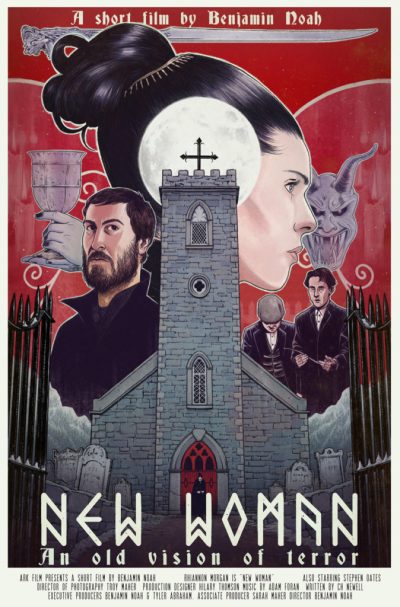
Harbour Grace will be featured in a new short film, New Woman, directed by Benjamin Noah and starring Rhiannon Morgan and Stephen Oates. You can view the new trailer here:

As described by the Newfoundland Quarterly, New Woman is a “gothic-romance [which takes] place just prior to the great St. John’s fire of 1892. The landscape of Newfoundland is also a lead actor in the film, though it’s a more foreboding and wild landscape than you’ve ever seen in a tourism commercial.”

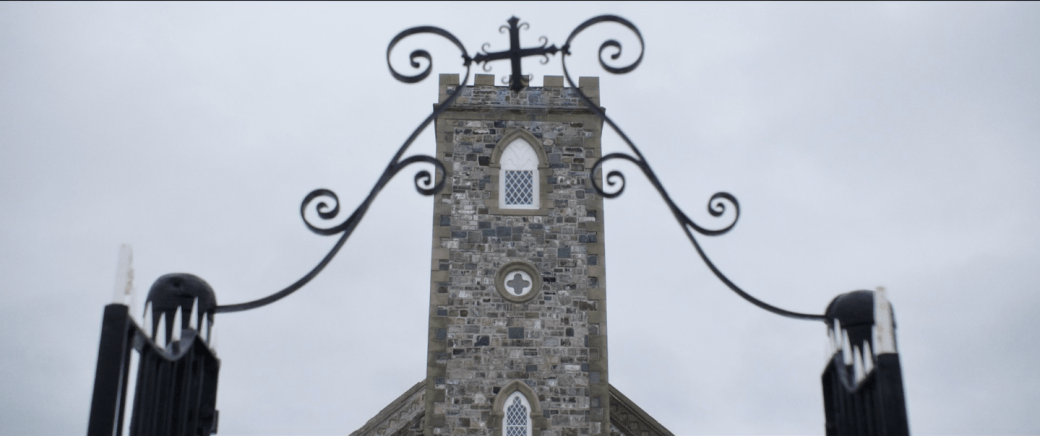
In an interview with the Compass, Noah said Harbour Grace, an “old, beautiful spot,” was an ideal location for filming: “When you’re shooting any sort of project set in an older time period, it can be kind of difficult when it comes to finding places to film, but Newfoundland has a lot of these really nice looking buildings and areas that, when shot the right way, can really look the part, like the church we filmed at today [St. Paul’s Anglican Church].”

Screen Shot 2019-02-06 at 1.04.17 PM

St. Paul’s Anglican Church (1835)

Screen Shot 2019-02-06 at 1.02.41 PM

St. Paul’s Anglican Church (1835)

Screen Shot 2019-02-06 at 1.03.08 PM

Stevenson’s rock wall, Water St, Harbour Grace

Screen Shot 2019-02-06 at 1.02.01 PM

Harbour Grace Islands

Screen Shot 2019-02-06 at 6.53.39 PM

St. Paul’s Anglican Church (1835)

New-Woman-Official-Poster-674x1024

New Woman poster, featuring St. Paul’s Anglican Church

Look out for New Woman soon at a film festival soon.

Links & Further Info

NQ interview | Compass profile | Benjamin Noah Vimeo

Profile: Harbour Grace Grammar School, 1845-1902

48362362_899711280234881_8463724379551825920_n

In the spring of 1843, an act was passed establishing a Grammar School at Harbour Grace. A grant of £400 was allocated to support the school. A Board of Commissioners was established as well, consisting of three members from the Church of England, three from the Roman Catholic Church, and three from other denominations. The chairperson was Dr. William Archibald Stirling, the prominent local surgeon.

For the position of headmaster, twenty-three applications were submitted, including one from Thomas Talbot, who would later become an MHA, Sheriff of the District Court, and teacher at St. Bonaventure’s College, St. John’s. However, John Irving Roddick, of Jedborough, Scotland, was chosen as headmaster. Roddick’s grandfather, Martin, had considerable interests in Newfoundland, owning a fleet of ships which traded in the colony. Roddick had originally trained for the ministry, before settling on teaching as a profession. Notably, he was a friend of the eminent Scottish writer Thomas Carlyle. Roddick’s salary was one hundred and fifty pounds per annum.

Built by Thomas Kitchen, the Grammar School officially opened on February 3, 1845, with fifty-five students registered. The school was located near the courthouse, a little west on Harvey St. Families paid seven and sixpence for their children’s registration every quarter. Students had three weeks vacation in the summer, three weeks at Christmas, and a week at Easter. Many Grammar School alumni went on to become prominent members of Newfoundland society, notably William Azariah Munn and the headmaster’s own son, Sir Thomas Roddick. Unsurprisingly, the Grammar School was considered one of the best schools in Newfoundland at the time.

James D. Munn succeeded Roddick as headmaster. The school was closed briefly but reopened in 1898 as a boys school, with Levi Thomas Chafe as principal.

The school operated until 1902, when the school’s committee decided to close the institution, citing its unfavourable location: most pupils lived in the town’s west end, and a school on Downing St was more convenient.

Chafe and his family continued living in the building and its attached dwelling, formerly a dormitory for out-of-town students, until 1906, when he left to become manager of Murray & Crawford at Harbour Grace. The adjacent homeowner, E.B. Thompson, then purchased the property, took down the schoolhouse and dormitory, and sold the land to R. Morrison.

Sources & Further Reading

Davis, May. “Harbour Grace History.” Newfoundland Quarterly, vol. 57, no. 1, 1957, pp. 21-22.

Fawkes, Marion Elizabeth. In Search of My Father: One Woman’s Search for the Father She Never Knew. Dundurn, 1994. Print.

Munn, W.A. “Harbour Grace History: Chapter Sixteen.” Newfoundland Quarterly, vol. 37, no. 3, 1937, pp. 9-14.
 

Profile: John Irving Roddick, Headmaster of the Harbour Grace Grammar School

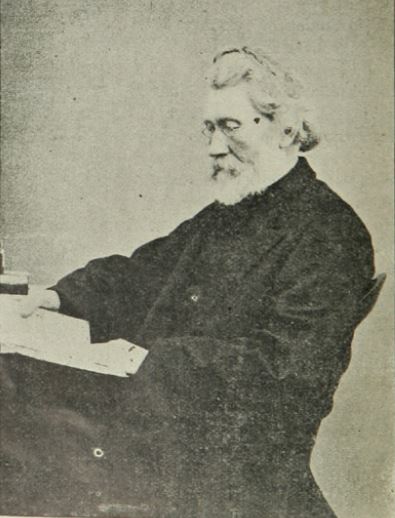
jiroddick1

John Irving Roddick, of Jedborough, Scotland, was the first headmaster of the Harbour Grace Grammar School. Roddick’s grandfather, Martin, had considerable interests in Newfoundland, owning a fleet of ships which traded in the colony; and his cousin was the famous preacher Edward Roddick. Roddick had originally trained for the ministry, before settling on teaching as a profession. Before coming to Harbour Grace, Roddick was a professor of classics at the High and Lower School of the Mechanics’ Institute in Liverpool, England. Notably, he was a friend of the eminent Scottish writer Thomas Carlyle.

His appointment aroused some indignation in Harbour Grace – some thought Thomas Talbot, a future MHA, Sherriff of the District Court, and teacher at St. Bonaventure’s College, St. John’s, better suited. In 1844 Roddick arrived in Harbour Grace on the brigantine Alert, captained by Azariah Munden. He was the first teacher to open the school on February 3, 1845. His salary was set at one hundred and fifty pounds per annum.

Soon after arriving in Newfoundland, Roddick married Emma Jane Martin, daughter of Harbour Grace merchant Thomas Martin, on October 2, 1845, at St. Luke’s Church, Port de Grave. The pair had five children: Thomas George (b. July 31, 1846), Janet Irving (b. July 8, 1848), John (b. July 4, 1850), Emma (b. May 18, 1852), and Margaret (b. unknown). Thomas was his father’s most well known pupil, later becoming a successful professor of surgery at McGill University and an influential MP.

At school, Roddick was a well-respected, strict disciplinarian, who insisted on punctuality for lessons. A former pupil described his mentor as “a scholar, linguist, systematic in his conduct of the school and one who never missed a day from attendance; a born teacher of youth, beloved by his pupils and a shrewd judge of character.” The Commissioners of the Grammar School in 1851 were similarly impressed: “[We] have much pleasure in expressing the utmost satisfaction with Principal Roddick, who, in the discharge of [the] onerous and important duties devolving on him, has continued to manifest that indefatigable zeal and ability which in a great measure it owes its efficiency, to whom the public stand indebted for its extended usefulness.” Under his guidance, the school was considered one of the best in Newfoundland.

During his time at Harbour Grace, Roddick was also treasurer for the Sons of Temperance Society and took a leading role in the Presbyterian community of Harbour Grace.

After his retirement from the Grammar School in 1876, Roddick and his wife moved to Montreal to be near their children. Roddick died there in 1879, his wife in 1890.

Sources & Further Reading

Davis, May. “Harbour Grace History.” Newfoundland Quarterly, vol. 57, no. 1, 1957, pp. 21-22.

Fawkes, Marion Elizabeth. In Search of My Father: One Woman’s Search for the Father She Never Knew. Dundurn, 1994. Print.

Munn, W.A. “Harbour Grace History: Chapter Sixteen.” Newfoundland Quarterly, vol. 37, no. 3, 1937, pp. 9-14.

Photo of the Day: Victoria Street, Harbour Grace, ca. 1950

200999905-1

From a postcard series of Harbour Grace: “Victoria Street, Harbour Grace, Newfoundland, R 4” ca. 1950.

Some historic structures visible in this photograph include:

  • Goodland House (ca. 1850)
  • Victoria Manor (1830)
  • Masonic Lodge No. 476 A.F. and A.M., S.C. (1868)
  • St. Peter’s Church (ca. 1907)

Photo source: Conception Bay Museum archives, photo no. 2009-99905-1.


Museum Fundraising Concert, Feb. 16

screen shot 2019-01-23 at 8.50.53 pm

Enjoy local music? Want to support our community’s heritage? Come to the Conception Bay Museum’s Fundraising Concert on Saturday, February 16, at St. Paul’s Hall, Harbour Grace. Musical acts include local favourites Chad Hunt, Long Drung, Pam Parsons, Paul & Brenda Stevenson, John Smith & Benny Lewis, and Kaitlyn Noel. There’ll be door prizes and the final 50/50 draw, too!

Event starts at 7:30 p.m. Tickets are $15.00 and available at the Harbour Grace Town Office, or by contacting Brenda Hunt-Stevenson (596-7549) or Patrick Collins (596-2172).

Proceeds from this event will go toward hiring a senior Coordinator/Curator for the third consecutive summer!

Date: Saturday, Feburary 16, 2019

Time: 7:30 p.m.

Cost: $15.00. Tickets available at the Harbour Grace Town Office, or by contacting Brenda Hunt-Stevenson (596-7549) or Patrick Collins (596-2172).

Photo of the Day: East End, Harbour Grace, ca. 1950

2009815-2

Taken from a postcard series of Harbour Grace, ca. 1950. Caption reads: “East End, Harbour Grace, Newfoundland, R 18.”

Some historic structures visible in this photograph include:

  • Knights of Columbus, Dalton Council (ca. 1909)
  • St. Paul’s Church (1837)
  • Masonic Lodge No. 476 A.F. and A.M., S.C. (1867)
  • Old Post Office (ca. 1910)
  • Coughlan United Church
  • Point of Beach Lighthouse (1850) & R.D. McRae buildings
  • Customs House (1870)

 
Photo source: Conception Bay Museum archives, photo no. 2009-815-2.

Photo of the Day: Harbour Grace Island, ca. 1950

2009809

Taken from a postcard series of Harbour Grace, ca. 1950. Caption: “Harbour Grace Island, Newfoundland, R 5.”

Like its neighbour Carbonear Island, Harbour Grace Island had several rough fishing stages in the sixteenth and seventeenth centuries. To the left of this photo is “Eastern Rock,” where a Spanish galleon, the St. Malo, reportedly beached during a battle with Peter Easton’s fleet. Over a century later, during his “Winter War” of 1696-7, Pierre Le Moyne D’Iberville destroyed stages and captured fishermen on Harbour Grace Island.

Photo source: Conception Bay Museum archives, photo no. 2009-809.